

On June 23, students from UC’s Urban Planning studio visited Batavia for their capstone presentations. Nine groups of juniors and seniors produced research projects for the steering committee of Agenda For the Future 2035 (AFTF). Good Day Clermont! interviewed Professor Shilpa Mehta and Clermont Agenda’s Liz Blume to debrief after the presentations.
Professor Mehta has over 13 years of professional work experience as a city planner, urban designer, and architect with an interest in urban placemaking and civic engagement. In her eight years of teaching, she has helped students broaden their understanding of urban planning and design issues, including climate action, sustainability, and multimodal transportation.
Listen to the latest episode of “Good Day Clermont!”
Under Mehta’s guidance, undergraduates from the University of Cincinnati have worked on a variety of real-world projects in both urban and rural communities, including international trips to South Korea. When Clermont leaders approached Mehta offering a capstone opportunity for her students, she expressed enthusiasm.
The classes of 2026 and 2027 have left a positive impression on Mehta throughout their education. She felt these were the right students for the task. “This group is a good mix of students who are interested in policy and design,” she said.
 Professor Shilpa Mehta & Clermont Agenda's Liz Blume
Mehta tasked her students to identify several key issues that Clermont faces in the coming decade, including:
Transportation bottlenecks
Suburbanization encroaching on natural land
Anxiety around the loss of community identity
Housing and tourism
Economic opportunities
The undergraduates prepared comprehensive presentations with proposed solutions, using various case studies as templates for Clermont County.
Mehta also credited Clermont’s existing efforts to address these issues as serving as a convenient springboard for students to gather data and target meaningful areas for improvement.
“The agenda for the future was what set them up to do that successfully,” she said. “One of the most useful conversations was around agriculture. We had clearly heard from the county that the rural character and that way of life is important.”
Mehta praised her students for addressing the economic drivers that protect both farmers and the cultural identity that surrounds small-town agriculture. “For agriculture to be valuable to the county, it has to do both. It has to have some economic output that then becomes a way to sustain it.”
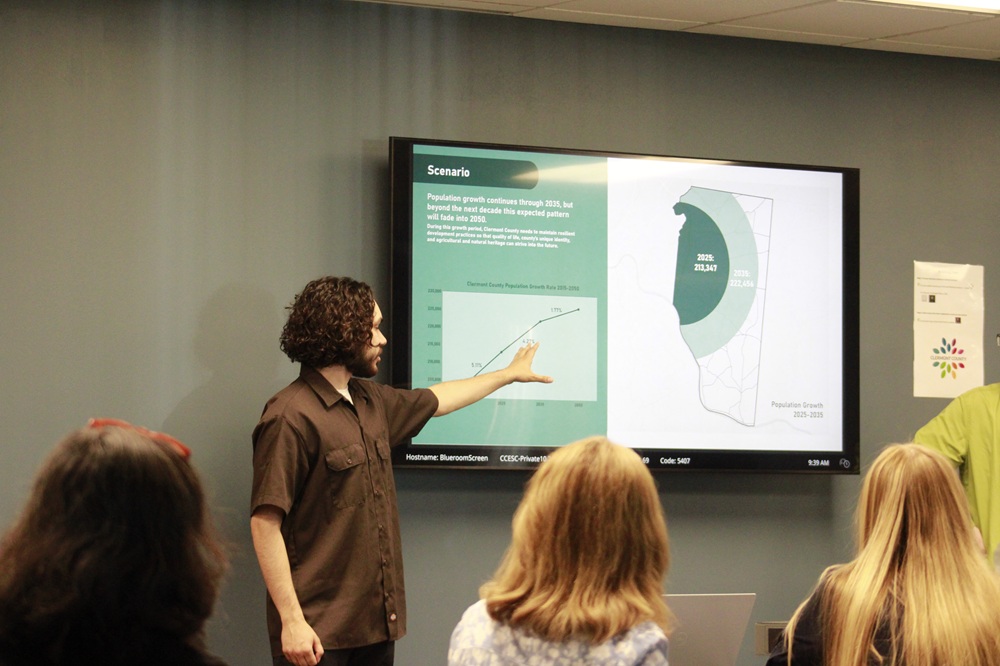 Students present to AFTF steering committee.
“Clermont County from 2014 on has said that balanced growth is really important, and that includes growing population and business, and preserving open space and agriculture. Not every county has that intentional objective. I think that was part of what gave them the enthusiasm to do the work that they did.”
Listen to the latest episode of “Good Day Clermont!”
In the interview, Blume congratulated Clermont County for winning a grant from the State Department of Agriculture to develop a new comprehensive plan.
Connect Clermont, among other notable organizations and nonprofits, has taken ownership of the plan’s execution. Blume emphasized the importance of ensuring organizations like these have the tools they need to implement change, and the students’ work has been a major contributor to setting that stage.
Mehta and Blume hope that the students can connect with urban developers in Clermont after their successful presentations. The information they provided to the AFTF steering committee raised new questions and potential solutions to explore as the county grows.
 Mehta & Blume.
Many of the undergraduates in the Urban Planning studio have completed co-op and work-study programs. These presentations allowed them to pitch ideas to real decision-makers and receive constructive feedback.
“We need these projects to keep our students engaged, so we think this is a mutually beneficial relationship,” Mehta added.
Keep up with Agenda For the Future.


Comments
No comments on this item Please log in to comment by clicking here