

On Wednesday morning, Veterans Day, press from Hamilton and Clermont counties lined up along the oak and coniferous trees at the Respite Gardens in Eden Park. The Sycamore Community Band, conducted by Bob Browning, performed jovial patriotic songs in front of the cameras as residents funneled into the area. To the right of the conductor, an honor guard donning green berets and camouflage fatigues sat in quiet respect, flanking their ceremonial rifles between their legs.
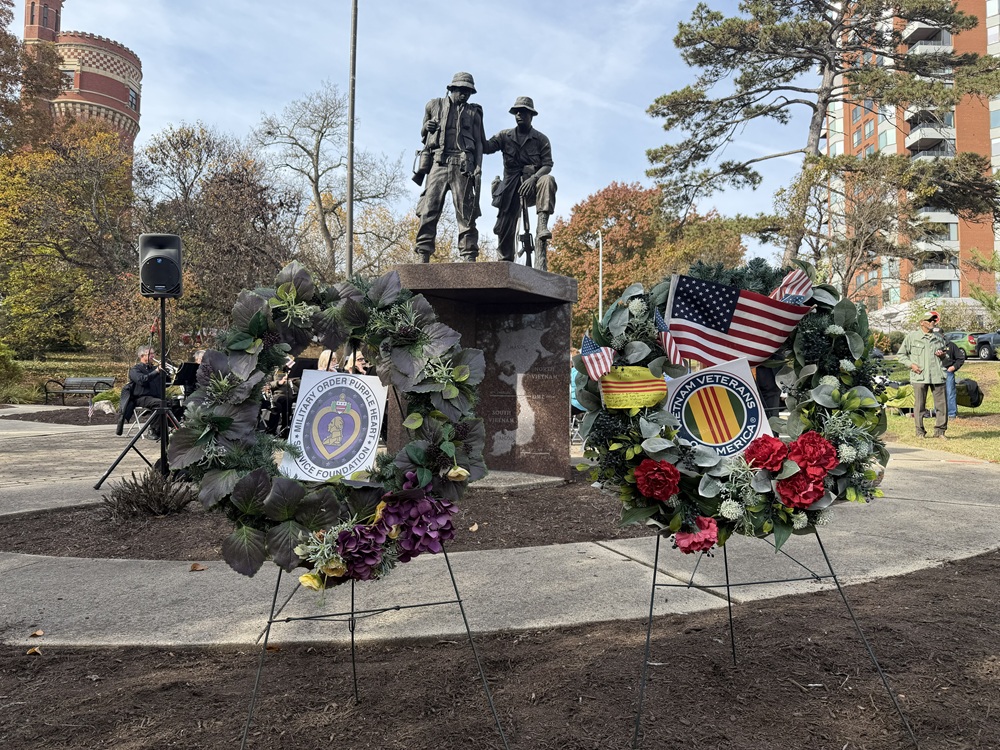 Remembrance wreathes in front of the current Vietnam Memorial in Eden Park.
Generations of veterans and their families filled rows of white chairs for this much-anticipated unveiling, with an empty seat reserved at the front for those who are captured or killed in action.
 Held In Service by Austen Brantley.
 Color guard displays flags of military service.
Women can’t handle it.
In a 15-minute recount of American history, Pillich reflected on the individual women and their contributions to warfighting and support of military operations, from the War of Independence to the modern era. She recognized the struggle women faced to be accepted into various roles and ranks, to revise uniform standards to accommodate their needs, and to win recognition for their fallen sisters in arms.
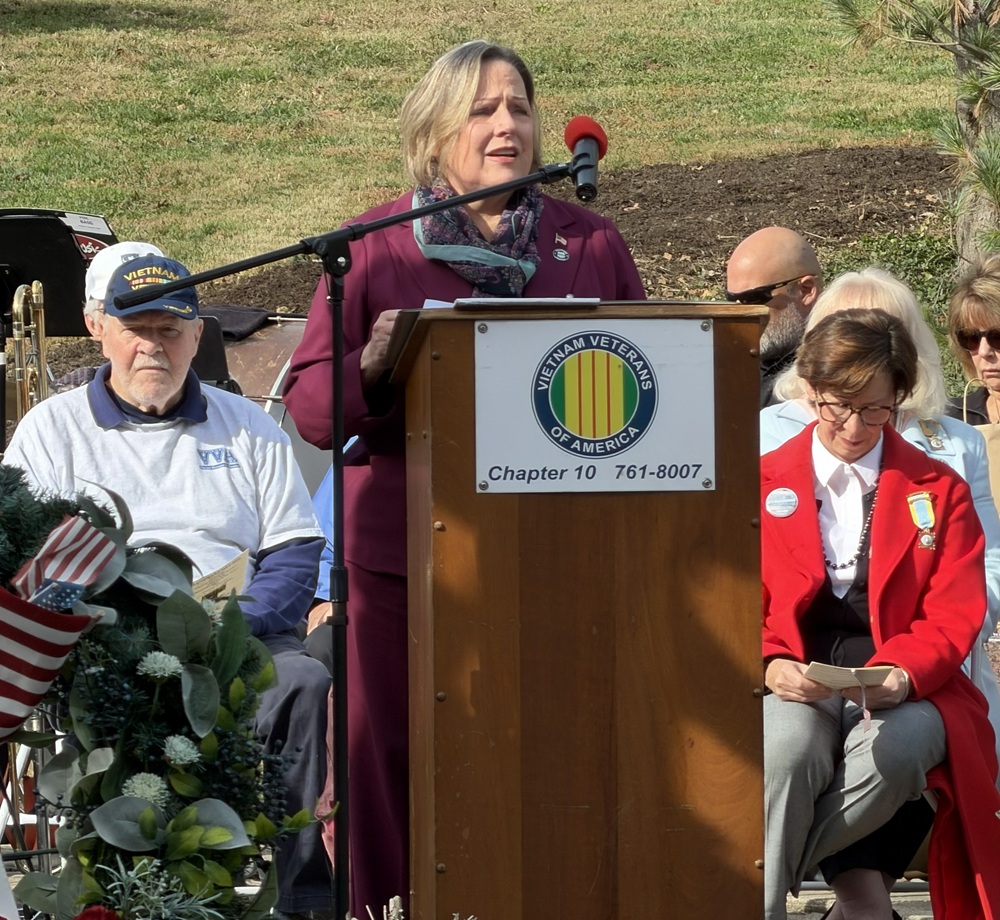 Air Force veteran Collie Pillich speaks at Eden Park.
“Women broke through the barriers and established themselves as capable service members,” Pillich insisted, invoking their role in the Iraq War where they operated on the ground to culturally mediate between Iraqi women and children on behalf of men. “They were needed, expressly because they were women.”
For centuries, women had to serve in limited capacity roles due to laws that excluded them from combat. Women veterans often oversaw medical and communications roles, but these roles came with their own challenges and sacrifices. Many veterans experienced traumatic experiences and loss of life near the front line in service to these roles, on which victory depended.
Pillich recalled her work in the legislature to introduce a resolution urging Congress to eliminate combat exclusion laws. She said she ‘couldn’t get enough men to sign it,’ ultimately causing the resolution to fail.
She again mocked the phrase, “Because women just can’t handle it. This is really what I heard from my male colleagues.”
 Crowds place flags at the base of the Vietnam Memorial in Eden Park.
“It was not an easy chore,” he said. “I started out asking the Air Force at Wright-Patterson Air Force Base, and they said, ‘We’d like to work with you, but let us check into it.’”
Brandt then asked the public affairs officer at Fort Knox, Kentucky. He claims the response he received was that ‘it would not be appropriate to have an all-female color guard.’
Several members of the audience shook their heads in judgment of those who have resisted women’s recognition within the military.
Many who seemed to express that same emotion were men wearing Vietnam War veterans caps. One could assume that many of these men worked closely with women during their service and feel a sense of shared camaraderie due to their experiences and interactions with servicewomen. Some may owe their lives to women veterans, and some may hold memories of these women and their bravery that they may never share with others.
 Rifle salute in Eden Park.
Unlike the solemn attitude expected at many memorial events, the design unveiling carried an atmosphere of pride and optimism for the men and women in attendance; as though the community had finally awarded these heroes some long-overdue appreciation.
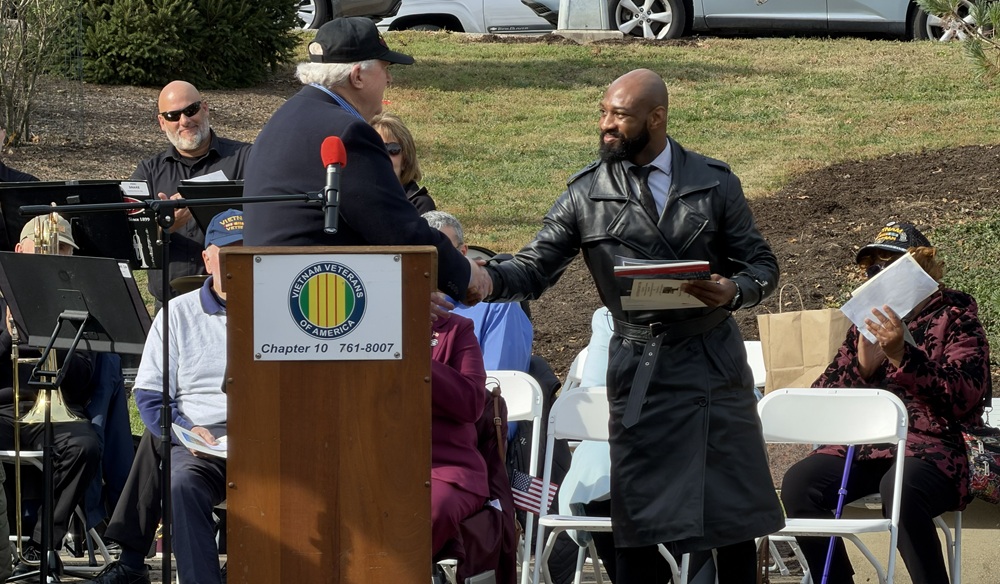 Artist Austen Brantley shakes hands with VVA Chapter 10 president.
By December 2015, the Department of Defense lifted the ground exclusion ban, and all military occupations (including infantry, armor, artillery, and special operations) were formally open to women as long as they met gender-neutral qualification standards; a step toward what many women veterans consider equal representation.
However, only recently has the Greater Cincinnati area taken steps to recognize women veterans’ distinct roles over more than 250 years of military history.
Kathryn Dierkes, of the National Society of the Colonial Dames of America, is largely responsible for organizing the memorial installation and bringing widespread attention to women veterans.
“May this place stand as a lasting expression of gratitude and respect,” Dierkes said during her speech. “May it invite reflection, deepen understanding, and remind all who visit that service to our country has never been defined by a single role, title, or uniform.”
 Kathryn Dierkes and Austen Brantley.
Austen Brantley, a talented fine-arts sculptor who worked on other notable memorials across the country, began work on the piece earlier this year. He was present for the design reveal and reinforced the need to recognize women veterans as integral figures in American history.
According to Brantley, Henry Mosler's Birth of the Flag partly inspired the sculpture's design.
 Birth of the Flag by Henry Mosler.
Visitors will be able to approach and move around the figures, which will stand roughly five feet six inches tall.
“My hope is that those encounters create opportunities for recognition and conversation,” Brantley said. “A veteran might recognize something from her own experience, a family might recognize a mother, a grandmother, a sister, or a daughter. A child might ask who these women are, or were.”
Dierkes told the crowd that organizers need to raise the final $100,000 to complete funding for the memorial. Not mere moments after those words left her lips, a representative of the VVA Chapter 10 handed her what appeared to be a check, cracking a joke that they now only needed ‘another $99,000.’
Eden Park expects to reveal the completed installation on June 12, 2027, National Women Veterans Recognition Day.
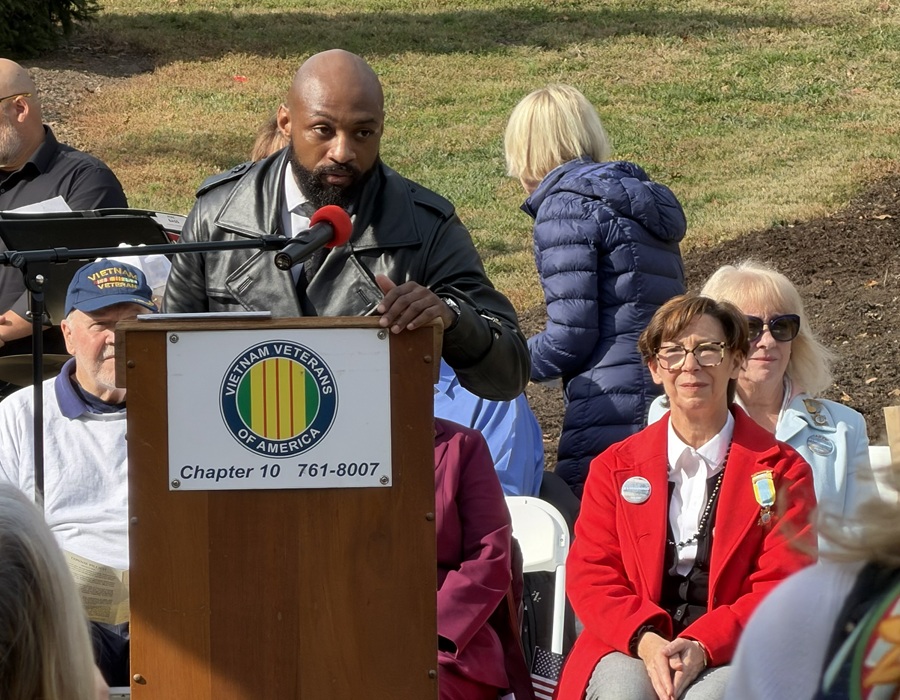 Austen Brantley honors women veterans.
Beyond the music of the Sycamore Community Band, the de rigueur of government proclamations, and heartfelt speeches by veterans and community organizers, perhaps the most striking feature of the morning was the size of the audience that turned out for this historic moment in Ohio.
The November air remained uncharacteristically mild throughout the event. With the American flag snapping against a clear blue sky, it was tempting to feel as though nature cooperated just for the occasion.
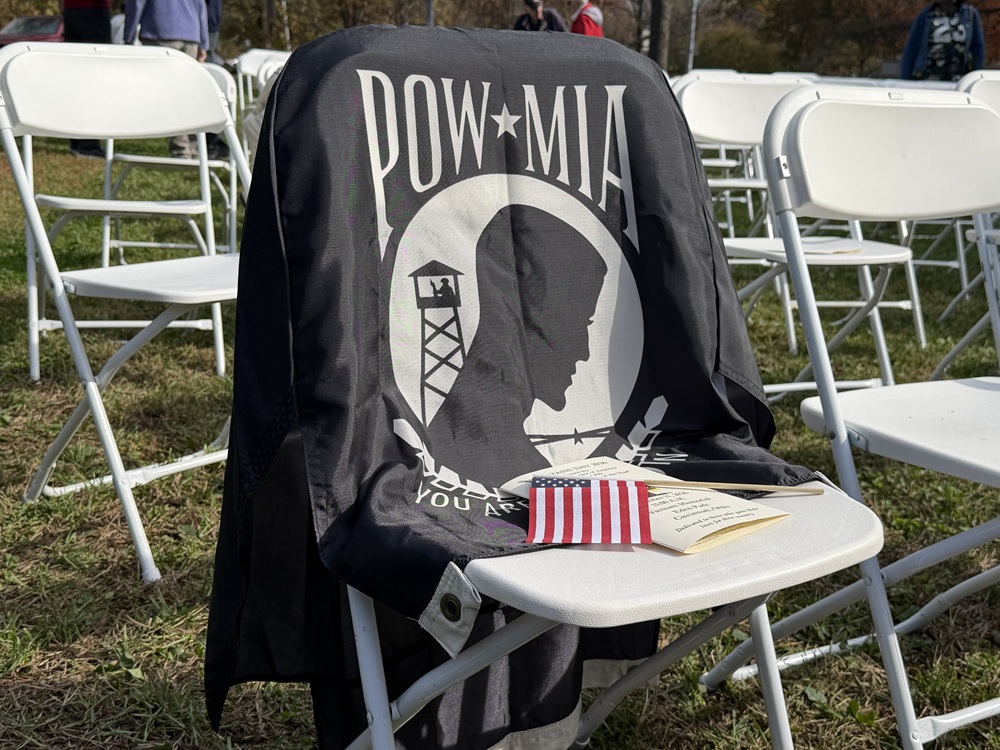 An empty chair reserved in honor of POW/MIA veterans.
It was clear to all in attendance that while this memorial will draw visitors from across the nation, it holds special meaning close to home. Located just 15 to 30 minutes from Clermont County and its active veteran community, the site will stand as a gathering place for countless men and women to pay their respects and share their stories.
Ultimately, the memorial will provide an enduring answer to a question that no person should have ever asked: Can women handle it?
Set permanently in stone, the response will be clear... Yes, they can.
Subscribe to Connect Clermont for more Good News.



Comments
No comments on this item Please log in to comment by clicking here